
Gulf County Jail Records Overview
The Gulf County Sheriff's Office runs the Gulf County Detention Facility in Port St. Joe, and Sheriff Mike Harrison leads the agency. Unlike many Florida counties, the sheriff does not post a searchable jail roster on its website. The official arrest-log page says the online log is unavailable and points readers to the Gulf County Sheriff's Office app for recent bookings. That app is the named channel for current jail records, and the jail phone line backs it up.
The county roster, wherever it appears, only covers local custody. Sentenced felons are not on it, because they move to the Florida Department of Corrections after a court commits them. Federal prisoners and immigration detainees are not on it either. For those groups the search moves to the state and national locators described further down, so a blank result in the app does not mean a person is free.
How to Use the Gulf County Inmate Roster
Because the recent-bookings list lives in the app, the workflow starts there and falls back to the jail and the records custodian. You need very little to begin, usually just a last name, though a date of birth helps when a name is common.
- Install the Gulf County Sheriff's Office app from the official app landing page, which links to both app stores.
- Open the recent bookings feature and search or scroll for the name.
- If the person is not listed, call the Gulf County Detention Facility at 850-227-1124 to confirm custody.
- For a booking record, report, or photo that the app does not show, file a public-records request with the sheriff's records custodian.
The OCV landing page is where the app download lives, with links for both Apple and Android devices.
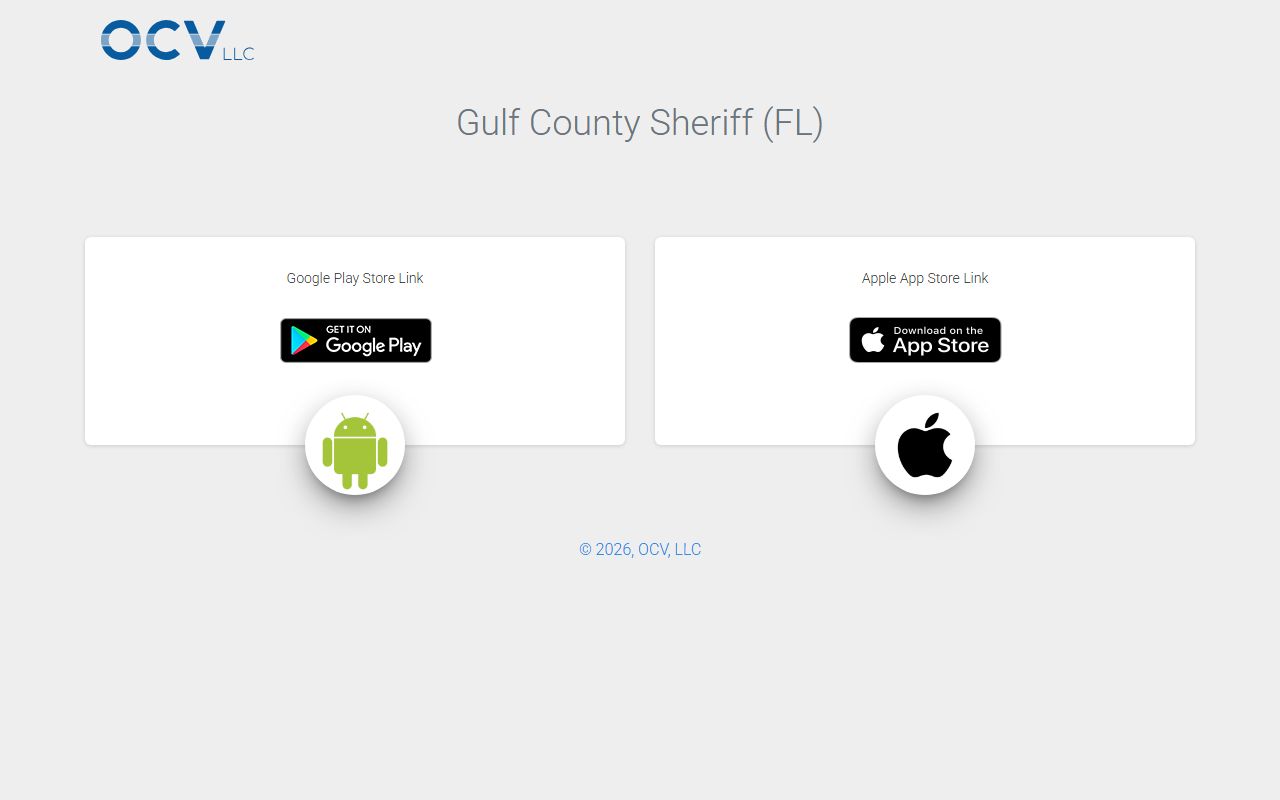
Once installed, the app is the closest thing the county offers to a live booking list, which is why the sheriff sends people there first.
What the Gulf County Sheriff App Covers
The app is published on the OCV platform and listed in both stores as the Gulf County Sheriff's Office app, with an Android package of com.ocv.gulfcountysheriff and an Apple App Store listing. The one feature the sheriff names in writing is recent booking information for the Gulf County Detention Facility, which is why it stands in for a web roster here.
Other features are not confirmed in the sheriff's published web text. A warrant search, a most-wanted list, a tip line, and a records-request tool may or may not be in the app, so this page does not promise them. Treat the app as the official recent-bookings channel and verify any other feature in the app itself. Note: a name missing from the app does not prove a person is free, since the app may lag intake or not list everyone.
Gulf County Roster Search Options
The sheriff website does not expose a web search form for the jail, so there is no online field set to complete. The table below is honest about that and lists the channels that actually return Gulf County inmate records, rather than search boxes the county does not publish.
| Channel | Type | What You Provide | Notes |
|---|---|---|---|
| Sheriff app recent bookings | Mobile app | Last name | Named by the sheriff as the recent-bookings source |
| Jail phone line | Call | Name, date of birth | 850-227-1124 confirms current custody |
| Records request | Written request | Name, booking details | For older or non-public booking records |
| Florida DOC search | Web form | Name or DC number | For sentenced state prisoners only |
What a Gulf County Inmate Profile Shows
Since the local jail does not publish a public web profile, the fields below describe what a booking record from the sheriff is expected to contain when you request it. The records custodian releases these details subject to any Florida exemption, and a booking charge here is only the arrest label, not the final court charge.
| Field | What It Shows |
|---|---|
| Name | The person booked into Gulf County custody. |
| Booking Date | When jail intake opened the booking. |
| Booking Number | The jail identifier for the booking, if one is used. |
| Charges | The arrest charges recorded at booking. |
| Bond | Bond amount or type when one is set. |
| Housing | The holding or housing area assignment. |
| Release Status | Held, bonded, released, or transferred. |
Booking photographs and the law around them are covered on the Gulf County jail mugshots page.
Finding County, State, and Federal Inmates
The county roster, the state locator, and the federal systems each hold a different group, and using the wrong one is the most common search mistake. Pretrial and short-sentence inmates are local. Sentenced felons belong to the Florida Department of Corrections. Federal and immigration detainees use national locators. The Florida DOC offender search even sits inside the county, since the Wewahitchka prisons report through it.
| Custody | Where to Look |
|---|---|
| Pretrial / short sentence | Gulf County Sheriff app, then jail phone |
| Sentenced felon | Florida Department of Corrections locator |
| Federal | Federal Bureau of Prisons locator |
| Immigration hold | ICE detainee locator |
The Florida DOC offender search menu lets the public choose among current population, releases, escapes, and supervised searches.
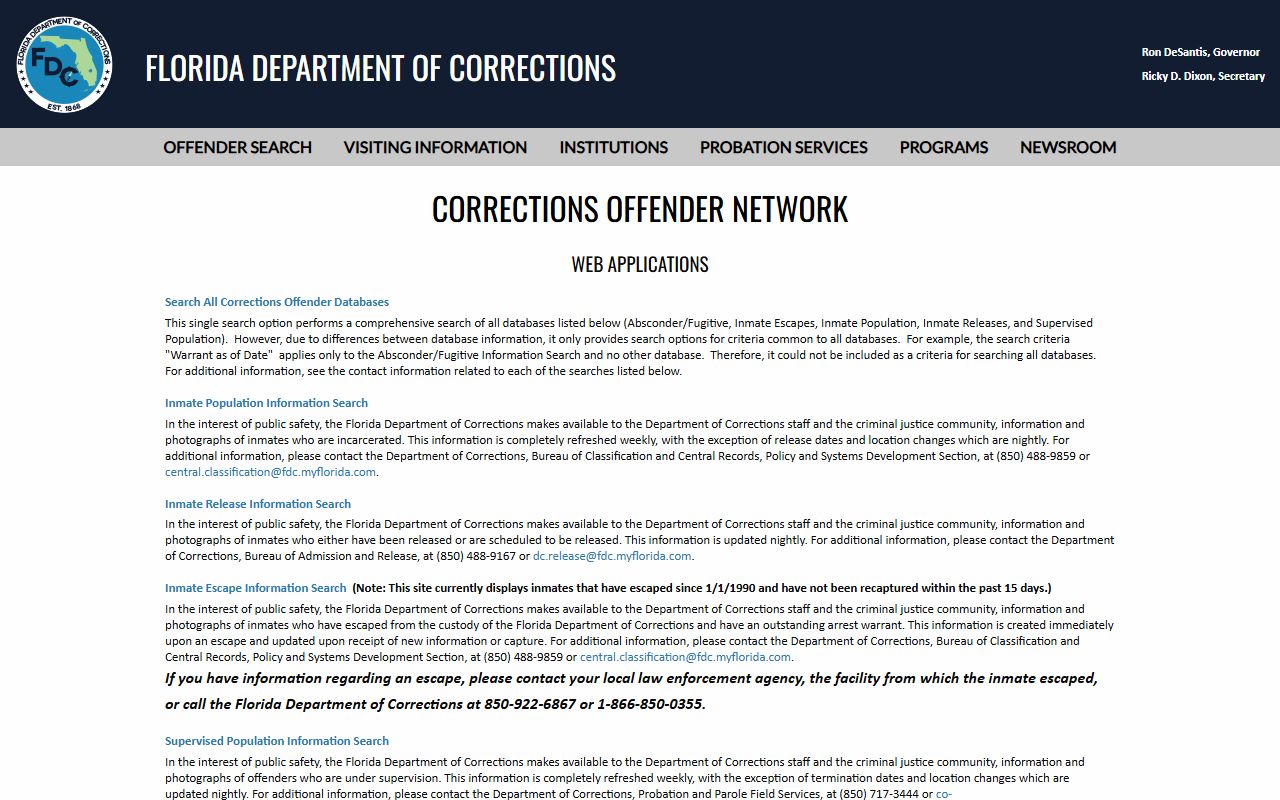
That menu, at the Florida DOC offender network, is where any sentenced Gulf County defendant is tracked after transfer. The federal BOP locator and the ICE locator handle the federal and immigration groups, and Florida VINELink sends custody alerts where it is supported.
Federal, Immigration, and VINELink Options
No federal prison or ICE detention facility sits in Gulf County, but a person arrested here can still end up in federal or immigration custody. The federal Bureau of Prisons locator covers federal inmates from 1982 to the present and can show a release or a not-in-custody result, though it is mainly for sentenced or BOP-held people rather than every federal pretrial defendant. For a federal pretrial case, the U.S. Marshals Service may hold a person in a contract facility, so the federal court or defense counsel is the better contact.
Immigration detainees are searched through the ICE detainee locator, usually by an A-number with country of birth or by biographical details, and that data can lag a recent transfer. Families who want to be told when custody changes can register with Florida VINELink, which sends notifications where the person is supported in the system. These tools cover the parts of the inmate population that never touch the Gulf County roster.
Gulf County Jail and Records Offices
Two addresses cover most Gulf County jail records work. The detention facility itself holds people and answers custody calls, while the sheriff's headquarters handles public-records requests through a designated custodian. The two sit on the same boulevard but at different building numbers.
Gulf County Detention Facility
1000 Cecil G. Costin Sr. Boulevard
Port St. Joe, FL 32456
850-227-1124
Jail information and custody line
Sheriff's Records Custodian
418 Cecil G. Costin Sr. Boulevard
Port St. Joe, FL 32456
850-227-1115
Fax 850-227-2097
Booking Process in Gulf County
Gulf County does not publish a detailed intake manual, so the picture here follows standard Florida practice with the local facts marked. An arrest by a deputy, a Port St. Joe officer, a Wewahitchka officer, or a state agency ends with the person taken to the Gulf County Detention Facility. Intake normally includes identity confirmation, a search, a property inventory, a booking photo, fingerprints, a medical screening, and an initial housing assignment. The sheriff does not state how quickly the app updates after intake, so a brand-new booking may not appear right away.
After booking, the person is checked for warrants and holds and reviewed for release. Some arrests carry a preset bond, while others wait for a first appearance. Florida practice generally brings an arrested defendant before a judge promptly, often within about a day. The booking charge is not the final charge, since the State Attorney reviews the reports and decides what to file. That court side is covered on the court records after a jail arrest page.
Visitation at Gulf County Facilities
Visitation rules depend on which facility holds the person, and the county jail and the state prisons work very differently. No official Gulf County Detention Facility visitation schedule was located, so the local hours must be confirmed by phone rather than read off a published calendar. The Florida Department of Corrections, by contrast, publishes a detailed visiting process for the Wewahitchka prisons.
| Facility | Visitation Process | How to Confirm |
|---|---|---|
| Gulf County Detention Facility | Schedule not published online | Call 850-227-1124 before visiting |
| Gulf Correctional Institution | Approval required, then weekly scheduling form | Florida DOC visiting information page |
| Gulf Correctional Institution Annex | Same Florida DOC approval and scheduling | Florida DOC visiting information page |
For the state prisons, a visitor must be approved first by filing application form DC6-111A, and visits are then booked through a weekly scheduling form. The full rules sit on the Florida DOC visiting information page. Note: always confirm custody and visiting status with the facility before you travel, since a transfer or status change can cancel a visit.
How to Contact a Gulf County Inmate
Mail and phone rules for the Gulf County Detention Facility are not published online, so the safe step is to call the jail at 850-227-1124 and ask for the current mailing format and phone vendor before sending anything. Jails screen mail and reject items that do not follow the rules, and an outdated address can mean returned letters.
For someone held in the state prisons, the Florida Department of Corrections runs statewide programs for inmate phone calls, tablets, and messaging, and those details live on the corrections department's own pages. The route into a sentenced prisoner is the state system, not the county jail.
Public Records Requests, Fees, and Exemptions
When a record is not visible in the app, a Florida public-records request to the sheriff is the formal way to reach it. The Gulf County Sheriff's Office lists a records custodian channel on its site, and requests for booking records, arrest reports, and mugshots go to the Records Custodian at 418 Cecil G. Costin Sr. Boulevard, Port St. Joe, FL 32456, by phone at 850-227-1115 or fax at 850-227-2097. The sheriff does not post a fixed fee or turnaround for these requests, so the practical step is to ask the custodian about any statutory copy charge before the request is filled.
Florida's public-records law sets the ground rules. Records are open for inspection and copying unless an exemption applies, a custodian may charge a reasonable cost for copies, and an office that withholds part of a record must cite the specific exemption rather than simply refuse. Active criminal investigative information and certain protected-person details can be redacted under those exemptions, which is why a booking record may come back with some fields blocked.
Commissary and Inmate Funds
The Gulf County Detention Facility does not publish a commissary vendor, deposit limit, or fee schedule, so no vendor is named here. Anyone wanting to add money to a local inmate's account should call the jail and confirm the current method first. The Florida Department of Corrections handles money for state prisoners through its own funds program, separate from the county.
Note: Confirm a person's custody and the current deposit rules with the jail by phone before sending money or scheduling a visit, since details change without notice.