
The Gulf County Inmate Population
Gulf County is a small Florida Panhandle county with its seat in Port St. Joe. The number of people behind bars inside its borders is larger than the local jail alone. Three detention facilities operate in the county. The Gulf County Detention Facility holds local arrestees and pretrial detainees, and two Florida Department of Corrections prisons in Wewahitchka hold sentenced adult men. Because of that split, the Gulf County inmate population is counted by more than one agency, and no single roster shows everyone.
The local share of the count moves with daily events. An arrest by a Gulf County deputy, a Port St. Joe officer, or a Wewahitchka officer can add a person to the jail within hours. A bond hearing, a dropped charge, or a release can take a name off the list just as fast. When a person is sentenced to state prison, custody shifts from the sheriff to the state, and the search moves with it. The U.S. Census Bureau put the county resident population at 15,876 as of July 1, 2024, which gives a sense of how small the community around these facilities is.
Official Gulf County sources describe how custody works in the county. The sheriff lists a publicly available booking channel through a mobile app, the Florida Department of State publishes the jail address and phone number, and the state corrections department runs its own offender search. Pulling those threads together is what makes a Gulf County inmate search work.
Gulf County Inmate Population Statistics
Hard numbers for the Gulf County inmate population are uneven. The Florida Department of Corrections publishes a fixed bed capacity for each state prison in the county, and the Census Bureau publishes county demographics. The Gulf County Sheriff's Office and the Florida Department of State county jail directory do not publish a rated capacity or an average daily population for the Gulf County Detention Facility, so those figures are left as not published rather than guessed.
The table below gathers the figures that official sources do report. The county jail rows stay blank on purpose, since inventing a capacity or a daily count would be worse than leaving a gap. The Census Bureau's QuickFacts page for Gulf County is the source for the resident counts.
| Measure | Figure | Source / Year |
|---|---|---|
| County resident population | 15,876 | U.S. Census Bureau QuickFacts, 2024 estimate |
| Gulf Correctional Institution capacity | 1,572 | Florida DOC institution page, 2026 |
| Gulf Correctional Institution Annex capacity | 720 | Florida DOC annex page, 2026 |
| County jail rated capacity | Not published | Not in sheriff or state jail directory |
| County jail average daily population | Not published | No county jail report located |
The image below shows the Census QuickFacts profile, where the resident figures and demographic shares come from. Reading that page is a good way to confirm any number quoted here before relying on it.
The Census Bureau's data portal for the county opens with population totals and age and sex breakdowns.
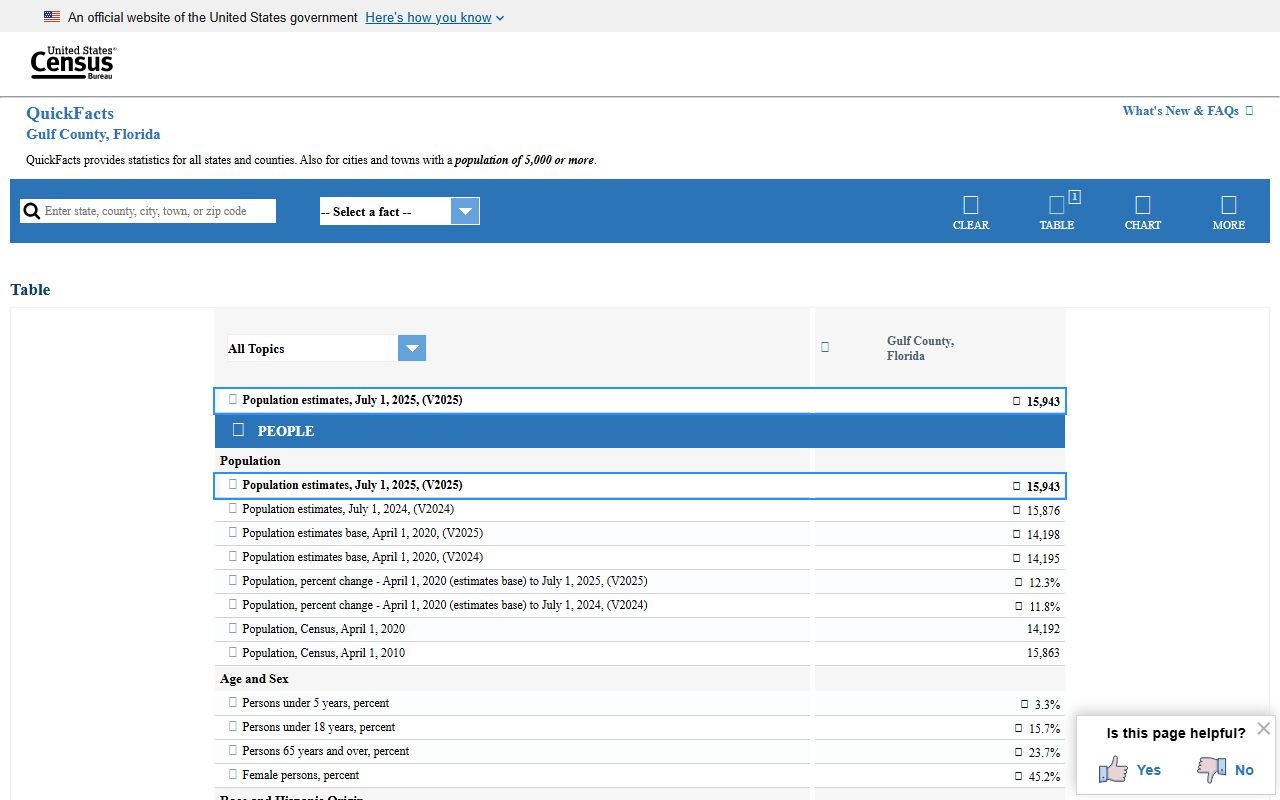
Those resident demographics are county-wide and are not a profile of the jail. They matter here only as background for how large the Gulf County inmate population could be against a community of fewer than 16,000 people.
Tracking the Gulf County Inmate Population Over Time
A clean year-by-year jail count for Gulf County is not published by any official county source, so a true local time series cannot be shown without inventing it. What can be tracked is the county resident population, which sets the backdrop, and the statewide jail context that the Vera Institute reports for Florida.
| Year | Gulf County Residents | Note |
|---|---|---|
| 2010 | 15,863 | Census count, used for long-run context |
| 2020 | 14,192 | Decennial census count |
| 2024 | 15,876 | Census Bureau estimate |
Statewide numbers fill in the part the county does not publish. The Vera Institute Florida trends page reports roughly 667,148 jail admissions across Florida in a year and finds that about 62 percent of the statewide jail population is pretrial, meaning held before any conviction. Gulf County's small jail is one piece of that statewide pattern, and the high pretrial share is a reminder that most people on a county roster have not been found guilty of anything.
The two state prisons in the county hold a steadier count, since their bed capacities are fixed. Gulf Correctional Institution is rated for 1,572 and its annex for 720, which together dwarf the local jail.
Who Makes Up the Gulf County Inmate Population
The Gulf County inmate population breaks into clear groups by where a person is in the process. The county jail and the state prisons hold different people, and the federal systems hold a third group that may pass through the county without ever appearing on a local list.
- Pretrial and short-sentence - people arrested locally and waiting on a first appearance or a case, plus those serving short county sentences, sit in the Gulf County Detention Facility.
- Sentenced state prisoners - adult men committed to the Florida Department of Corrections serve at Gulf Correctional Institution and its annex, both adult male facilities.
- Federal and immigration holds - no federal prison or ICE facility sits in the county, so these detainees are searched through national locators rather than a Gulf County roster.
- People held on detainers - a probation, out-of-county, or federal hold can keep someone in custody even after a local case is resolved.
Official county sources do not publish a sex, age, race, or charge-level breakdown of the jail population, so no such split is claimed here. The state prisons publicly state that they hold adult men only.
Gulf County Jail Capacity and Crowding
Capacity is one of the clearest gaps in the public record for this county. The Florida Department of State county jail directory lists the Gulf County Detention Facility with its address and phone number but no bed count, and the sheriff's website does not publish a rated capacity or a population report. Without those figures, no honest crowding rate can be calculated for the local jail.
The state prisons are different. The Florida Department of Corrections publishes a capacity of 1,572 for Gulf Correctional Institution and 720 for the annex. The corrections department also notes on the institution page that Gulf Forestry Camp, once a satellite of the prison, is temporarily closed, which lowers the number of beds actually in use in Wewahitchka.
Laws Behind the Gulf County Inmate Population Data
Florida law is what makes jail and inmate information open in the first place. The state's public-records chapter sets the default that custody records are available, spells out how a person inspects or copies them, and defines the limited reasons an office can withhold a record. A separate statute sets minimum standards for county detention facilities. Together they explain why a Gulf County booking record can be requested at all and why some details may be held back.
Key Statutes:
Florida Statutes § 119.01 - sets the policy that state, county, and city records, including jail records, are open for inspection and copying unless an exemption applies.
Florida Statutes § 119.07 - lays out how records are inspected and copied, what fees apply, and requires a custodian who withholds a record to cite the exemption.
Florida Statutes § 119.071 - lists exemptions, including active criminal investigative information and protected-person details that may be redacted.
Florida Statutes § 951.23 - defines county and city detention facilities and sets minimum standards, inspection, and enforcement for them.
One more point shapes the data. The Florida Department of Law Enforcement states that Florida has no state law requiring agencies to report deaths in custody to a central state system, so that particular metric is not collected at the state level. Note: a custodian who holds back part of a Gulf County record must point to the specific statute, not simply refuse the request.
Gulf County and the State Prison Population
A person only joins the state prison count after a court sentences them and commits them to the Florida Department of Corrections. At that point the Gulf County Detention Facility transfers custody, and the search moves to the statewide Florida DOC offender search. Reception and classification, run by the corrections department, decide where the person actually lands.
Gulf County is unusual because two of those state prisons sit inside the county. Gulf Correctional Institution and its annex in Wewahitchka hold sentenced men from across Florida, not just locals, so a name found at a Wewahitchka prison is not evidence of a Gulf County case. That distinction trips up a lot of searches and is worth keeping in mind.
How to Search the Gulf County Inmate Population
The local starting point is not a website roster. The Gulf County Sheriff's Office publishes an arrest-log page that states the online log is unavailable and that recent booking information for the Gulf County Detention Facility is available through the Gulf County Sheriff's Office mobile app. That makes the app the named first stop for a current local inmate.
You do not need much to start. A last name is enough for most searches, and a booking number or date of birth helps when the name is common. The steps below follow the channels the sheriff and the state actually publish.
- Open the Gulf County Sheriff's Office app from the official app landing page and check the recent bookings list.
- If the app does not show the person, call the Gulf County Detention Facility at 850-227-1124 to confirm custody.
- For a booking record, mugshot, or older material, send a public-records request to the sheriff's records custodian in Port St. Joe.
- If the person was sentenced to prison, search the Florida DOC offender network instead of the county channels.
- For a possible federal or immigration hold, use the federal BOP or ICE locators.
The arrest-log page itself spells out that the recent bookings live in the app rather than on the website.
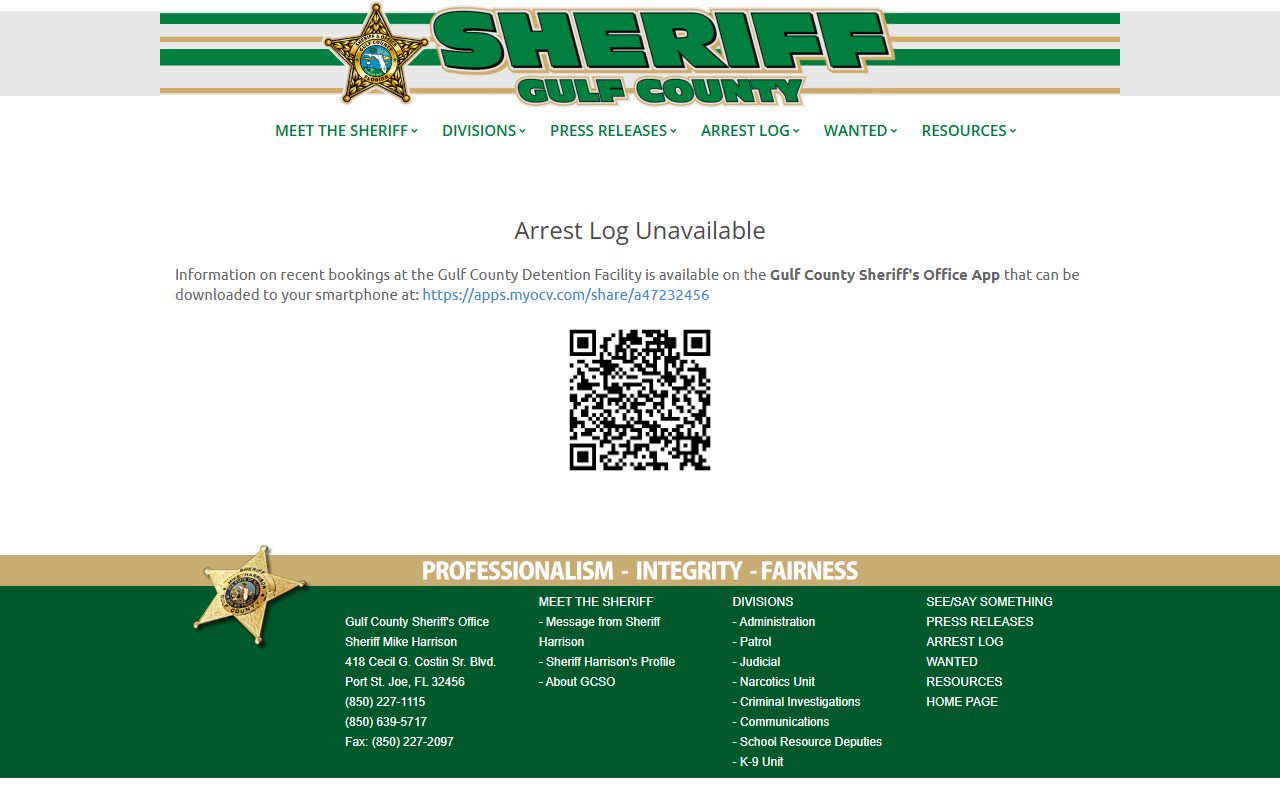
Because that page sends readers to the app, the app is the closest thing Gulf County has to a public booking roster. The Gulf County jail inmate records page walks through each fallback in more detail.
Current Inmate Lookup in Gulf County
For someone believed to be in the local jail right now, the sheriff app is the official recent-bookings source, and the jail phone line confirms custody when the app comes up empty. The sheriff's website does not expose a web search form for the jail, so there are no online roster fields to fill in. The table below reflects what the official arrest-log page actually offers rather than inventing search boxes the county does not have.
| Field Label | Type | Required | Notes |
|---|---|---|---|
| Web search form | None | n/a | The arrest-log page does not publish a web roster form |
| App download link | Hyperlink | n/a | Directs to the Gulf County Sheriff's Office app |
| Jail phone | Call | n/a | 850-227-1124 confirms current custody |
The statewide picture is different for sentenced prisoners. The Florida DOC offender search lets the public search by name or DC number across several databases, with photos and current location, and the corrections department refreshes most of that information weekly.
Past and Released Inmate Records
Finding someone who is no longer in custody takes a different route. The sheriff does not publish how long a released person stays visible in the app, so the reliable path for an older booking is a public-records request to the Gulf County Sheriff's Office records custodian at 418 Cecil G. Costin Sr. Boulevard in Port St. Joe. The custodian can pull a booking record, arrest report, or mugshot that is no longer shown in the app.
For a person who was sentenced and later released from prison, the Florida DOC offender network keeps a separate inmate release search that is updated nightly. The county jail covers current local detainees, while released-prisoner history belongs to the state system, so the two searches rarely overlap.
What a Gulf County Inmate Record Shows
Because the local jail does not expose a public web profile, the fields below describe what a booking record from the Gulf County Sheriff's Office is expected to contain when you request it, not a confirmed app screen. The sheriff's records custodian is the office that can release these details, subject to any Florida exemption.
| Field | What It Shows |
|---|---|
| Name | The person booked into Gulf County custody. |
| Booking Date | When jail intake created the booking record. |
| Arresting Agency | Sheriff, Port St. Joe police, Wewahitchka police, or another agency. |
| Charges | Arrest charges at booking, which can differ from the charges a prosecutor files. |
| Bond | Bond amount or type if one is set and releasable. |
| Mugshot | Booking photograph, requested through sheriff records if not in the app. |
| Release Status | Still held, bonded out, released, or transferred. |
Booking photos and the rules around them are covered on the Gulf County jail mugshots page. Note: a booking charge is only the arrest label, so the final court charge can be different once the case is reviewed.
County Jail vs. State Prison: Where to Look
The single biggest source of confusion in a Gulf County inmate search is mixing up the jail and the prisons. Pretrial detainees and short-sentence inmates stay in the county jail run by the sheriff. Sentenced felons move to a Florida Department of Corrections prison, which has its own locator. The table sorts out which system covers which part of the population.
| County Jail | State Prison (DOC) | |
|---|---|---|
| Who Is Held | Pretrial and short county sentences | Sentenced state felons |
| Run By | Gulf County Sheriff's Office | Florida Department of Corrections |
| Where to Look | Sheriff app, then jail phone | Florida DOC offender search |
| How to Confirm | Call 850-227-1124 | Bureau of Classification, 850-488-9859 |
State and Federal Inmate Search
Three outside systems round out a Gulf County search. The Florida DOC offender network covers sentenced state prisoners, including the men held in Wewahitchka. The federal Bureau of Prisons locator covers people in federal custody from 1982 forward. The ICE detainee locator covers immigration holds. Each one covers a slice of the broader inmate population that the county roster will never show.
Victims and families can also register for custody alerts through Florida VINELink, which sends a notice when a supported inmate's status changes. That service spans county and state custody where it is supported.
Gulf County Detention Facilities
Three facilities hold part of the Gulf County inmate population, and each one is searched a different way. The primary jail is the local sheriff's facility, and the two state prisons are run by the Florida Department of Corrections.
- Gulf County Detention Facility - the county jail in Port St. Joe for local arrestees, pretrial detainees, and short county sentences.
- Gulf Correctional Institution - a state prison in Wewahitchka for sentenced adult men, searched through the Florida DOC.
- Gulf Correctional Institution Annex - the adjoining state prison annex in Wewahitchka, also for sentenced adult men.
Gulf County Inmate Population FAQ
How big is the Gulf County inmate population?
No official source publishes a daily count for the Gulf County Detention Facility, so an exact local number is not available. The two state prisons in Wewahitchka are rated for 1,572 and 720 beds, and the county itself has about 15,876 residents as of the 2024 Census estimate. Those figures set the scale even though the day-to-day jail total is not reported.
How do I search the Gulf County inmate population?
Start with the Gulf County Sheriff's Office app, which the sheriff names as the recent-bookings source. If the person is not there, call the jail at 850-227-1124. For a sentenced prisoner, use the Florida DOC offender search instead. Federal and immigration detainees are found through the BOP and ICE locators rather than any county tool.
Can I look up a released or past Gulf County inmate?
Yes, but not always online. For an older local booking, send a public-records request to the Gulf County Sheriff's Office records custodian in Port St. Joe. For a released state prisoner, the Florida DOC keeps a separate inmate release search that is updated nightly. The county app is geared toward current bookings, not history.