
Gulf County Court Records After a Jail Arrest
An arrest in Gulf County is only the start of a case. After booking at the jail, the file goes to the State Attorney for the Fourteenth Judicial Circuit, led by Larry Basford. The prosecutor decides what to charge, and the formal filing opens a court record kept by the Gulf County Clerk of Court and Comptroller, James M. Terry. From that point, the court record, not the arrest paperwork, is the authoritative account of the charges and how the case moves.
It helps to keep the two sides apart. The booking and custody side lives with the sheriff, and you can follow it through Gulf County jail inmate records and the booking photo on the jail mugshots page. The court record is separate. It holds the charges the prosecutor filed, the docket, the rulings, and the disposition, which is why court records after an arrest often look different from what the booking charge first suggested.
How to Find Gulf County Court Records After an Arrest
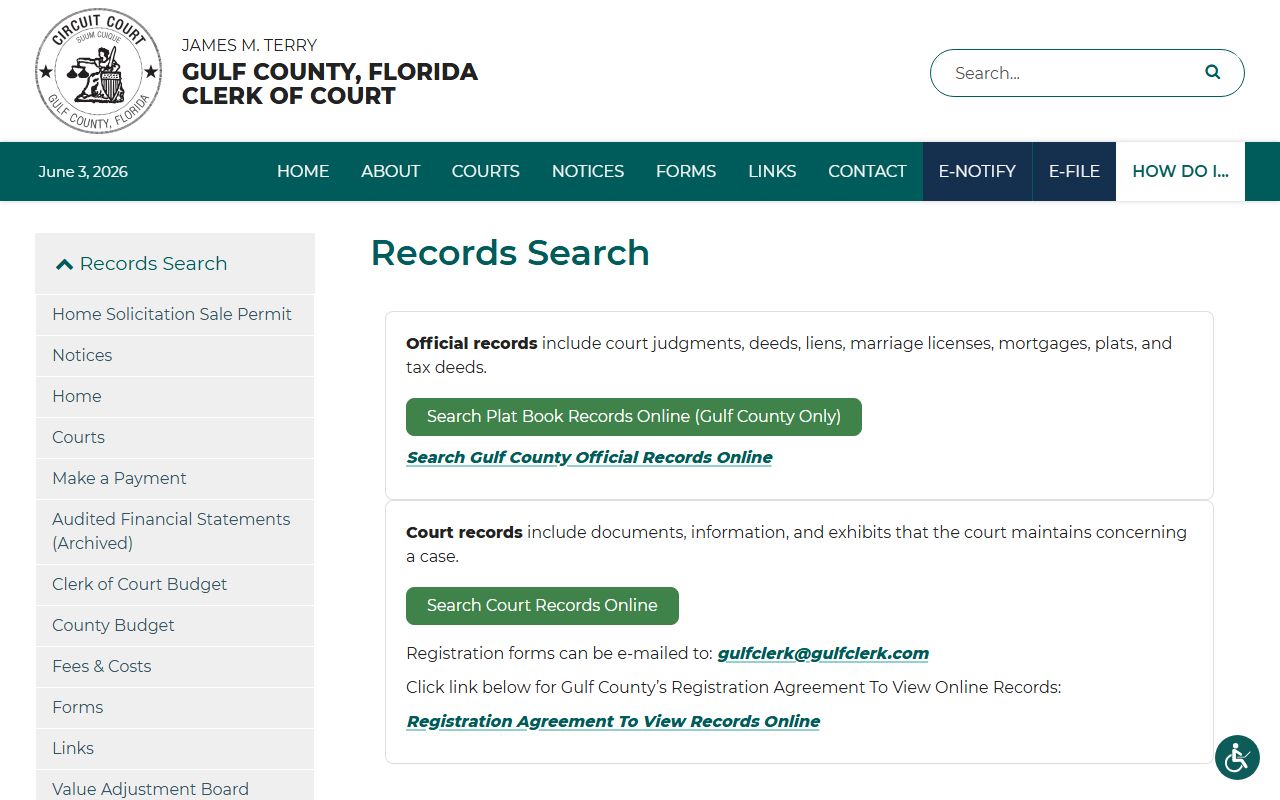
The clerk publishes court records through an online case index. The clerk's record-search page links to the CiviTek system, where the public can search Gulf County court cases. The clerk's office also handles registration for the deeper access levels and answers questions by phone when an online search comes up short.
- Open the clerk's record-search page and follow the link to the CiviTek Gulf County court records.
- Choose the public access option and search by defendant name or case number.
- Open the case to read the filed charges and the docket entries.
- Check each charge for its level and current status, then note the disposition if the case has closed.
The clerk's record-search page is the front door to the online court index.
For a statewide criminal-history check rather than a single case, the Florida Department of Law Enforcement runs a separate criminal history service that the sheriff's resource page also points to. That is the route when you need a person's full record across counties, not just a Gulf County case.
CiviTek Court Record Access Levels
The CiviTek Gulf County system offers four ways in, and only one is open to the general public without credentials. The others require a user ID and password and are limited to attorneys, registered users, and parties to a case. Online access is governed by Florida Supreme Court order AOSC 16-107, and the clerk's office issues the credentials for the restricted levels.
| Access Level | Login | Who It Is For |
|---|---|---|
| Public | None | Anonymous access to open court records |
| Attorney | User ID and password | Attorneys of record on their own cases |
| Registered User | User ID and password | Approved users with broader access |
| Party Access | User ID and password | Parties to a specific case |
The CiviTek access screen lays out those four options side by side.
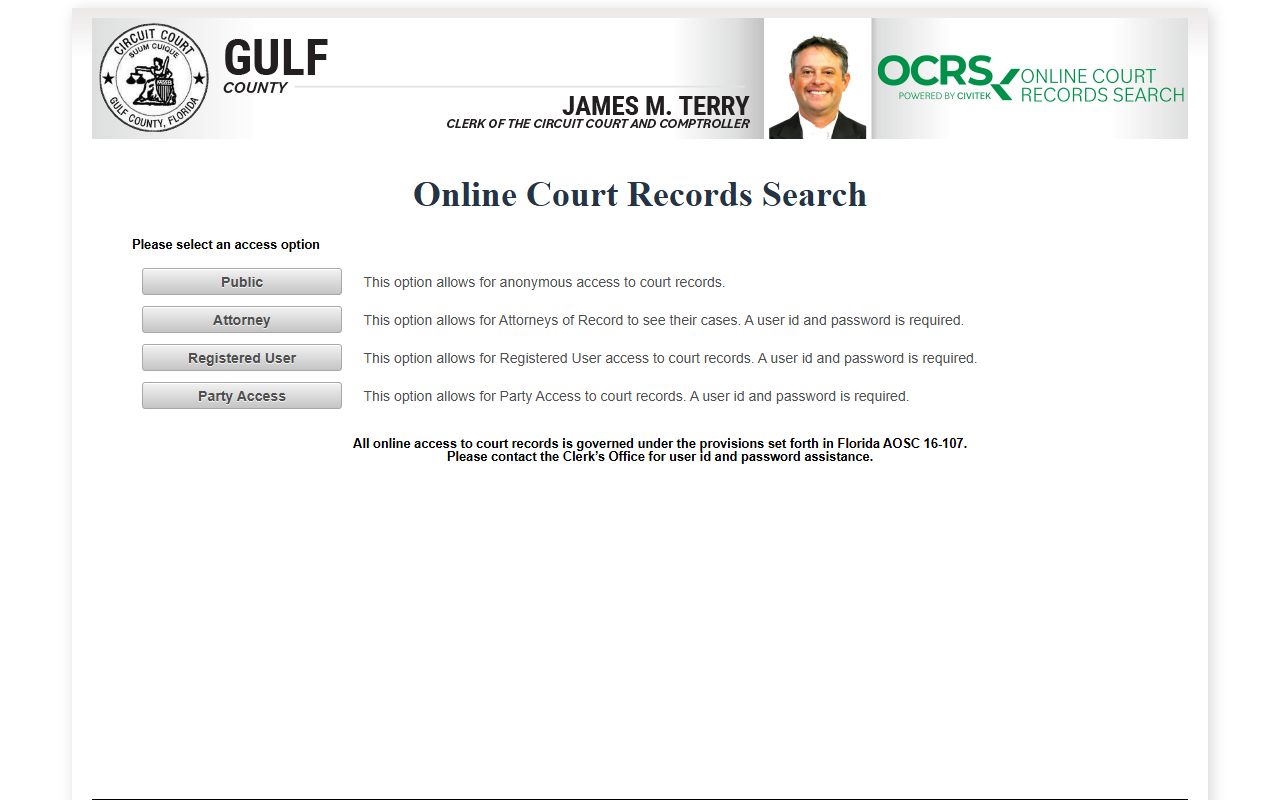
For most people checking court records after an arrest, the public CiviTek option is enough to see the charges and the docket.
How Charges Get Filed After an Arrest
The court record begins when a charging document is filed, and the type depends on the case. The clerk's criminal pages explain that the circuit court handles felony defendants while the county court handles misdemeanors and criminal traffic. A booking at the jail starts the clock, but it is the prosecutor's filing that turns an arrest into a case the court can act on.
| Complaint | Information | Indictment | |
|---|---|---|---|
| Filed By | Officer or prosecutor | State Attorney | Grand jury |
| Common For | Misdemeanors | Many felonies | The most serious felonies |
| Starts | The case | The case | The case |
Charge Status in Court Records
Charges rarely stay frozen. As a case moves, the prosecutor can amend, reduce, add, or drop a count, and a judge can dismiss one. The booking charge on the jail side often differs from what finally appears in the court record, since the State Attorney reviews the reports before filing. The terms below show up again and again in a Gulf County docket.
| Status | What It Means |
|---|---|
| Pending | The charge is filed and the case is still open. |
| Amended / Reduced | The charge was changed, often to a lesser offense. |
| Dismissed | A judge ended the charge without a conviction. |
| Nolle Prosequi | The prosecutor chose to drop the charge. |
Note: a failure to appear can change everything, since the clerk's felony page warns it may bring a warrant, forfeit a posted bond, and lead to a no-bond hold if the person is arrested on it.
Bond and Release After an Arrest
Bond is usually set at or before a first appearance, and the form it takes decides how a person gets out. The clerk's felony page adds a local detail worth knowing, that under Florida law a cash bond can be applied to court costs or fines the court assesses. A hold or detainer can keep someone in custody even after a bond is posted.
| Bond Type | How It Works |
|---|---|
| Cash Bond | The full amount is deposited and may be applied to costs or fines. |
| Surety Bond | A licensed bail agent posts the bond for a fee paid to the agent. |
| Release on Recognizance | The court releases the person on a written promise to appear. |
| No-Bond Hold | Release by payment is not allowed until the court or a hold clears. |
To confirm a bond on the custody side, use the sheriff app or call the jail at 850-227-1124. For court costs and case obligations, the Gulf County Clerk is the office to call.
Warrants That Lead to an Arrest
An outstanding warrant is a common reason a person ends up booked. The Gulf County Sheriff's Office keeps a wanted page, though no searchable warrant list was visible there during research, and the agency's Judicial Unit handles courthouse security and civil process rather than a public warrant database. To check for a court warrant tied to a missed hearing, the clerk's criminal divisions are the better call.
The clerk lists separate extensions for the two case types, with one line for criminal traffic and misdemeanor matters and another for felony and appeals questions. Anyone who thinks they may have an active warrant should speak with the clerk, the court, or counsel before going to the jail, because bond and hold status vary case by case.
Charges vs. Convictions
Being arrested and charged is not the same as being convicted. A charge is an accusation that opens a case, while a conviction is the outcome after a plea or a verdict. Both can appear in public court records, so reading a docket carefully matters.
| Charge | Conviction | |
|---|---|---|
| Stage | Accusation | Plea or verdict |
| Burden of Proof | Probable cause | Beyond a reasonable doubt |
| Public Record | Yes | Yes |
Sealed vs. Expunged Arrest Records
After a dismissal or an eligible outcome, Florida law lets some people seal or expunge a record. The two are not the same. Sealing limits public access, while expungement orders the record destroyed or treated as if it never existed. The clerk's felony page tells people to contact the clerk for sealing and expunging instructions, and the process runs through the court and the Florida Department of Law Enforcement under statutes 943.0585 and 943.059.
| Sealed | Expunged | |
|---|---|---|
| Visibility | Hidden from public view | Destroyed or treated as never existing |
| Law Enforcement | Limited access remains | Very limited access |
| Eligibility | Set by Florida statute 943.059 | Set by Florida statute 943.0585 |
The State Attorney's Role After an Arrest
The prosecutor is the office that turns an arrest into a court charge. The State Attorney for the Fourteenth Judicial Circuit keeps a Gulf County office in Port St. Joe, and Larry Basford holds the post. After booking, that office reviews the arrest reports and decides whether to file, what to file, and in which court.
The State Attorney's Gulf County contact block appears on the circuit's official site.
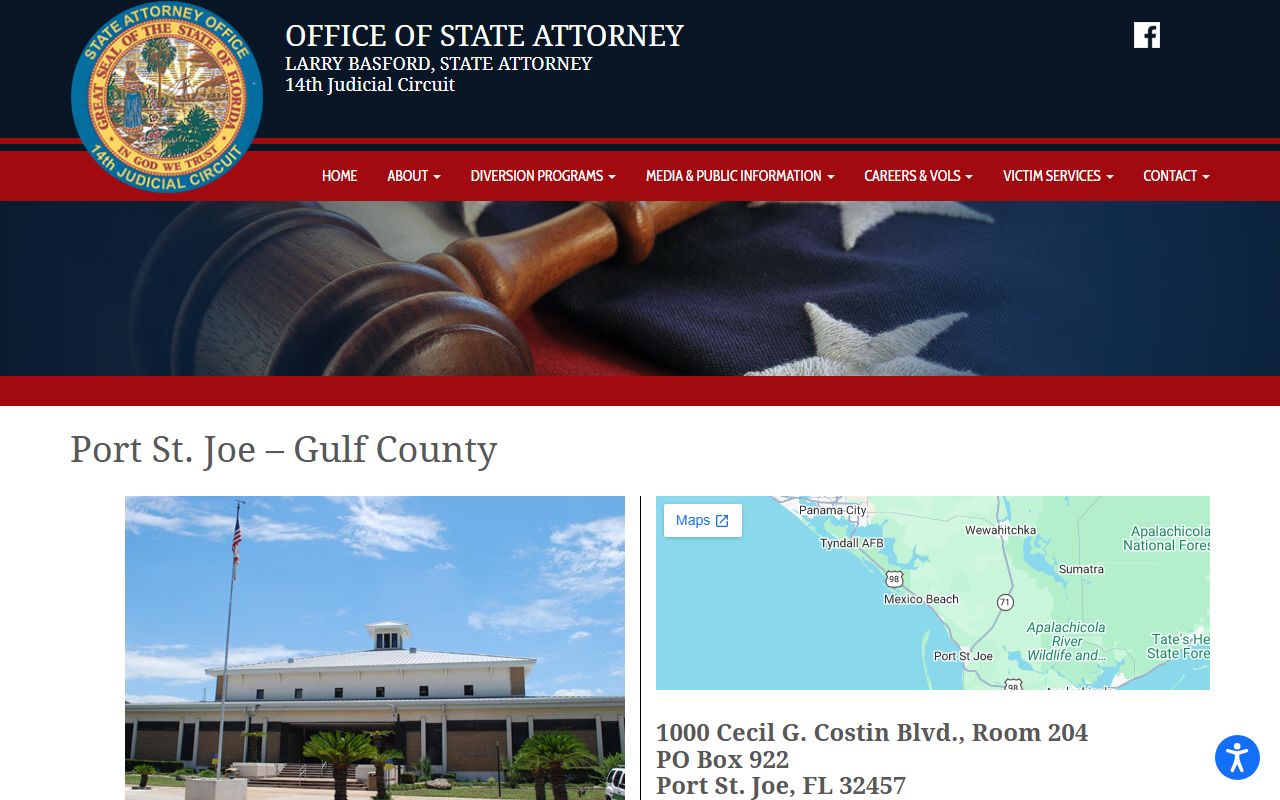
Because the prosecutor can charge differently from the booking sheet, the State Attorney's decision is often the moment the court record and the jail record stop matching.
Requesting a Disposition or Court Copy
When the online index does not show everything, the clerk can provide certified copies and disposition records by mail or in person. The clerk separates the two case types. The criminal court page explains that the circuit court handles felony defendants while the county court handles misdemeanors and criminal traffic, and each division has its own request process.
- For a felony judgment or sentence packet, mail a written request with $1.00 per page to the Clerk's Office Criminal Division at 1000 Cecil G. Costin Sr. Boulevard, Port St. Joe, FL 32456, and include a self-addressed stamped envelope.
- Allow about seven to ten working days for a felony request, since inactive cases may be stored offsite and take a day or so to retrieve.
- For a misdemeanor or criminal traffic copy, visit the office or mail a request with $1.00 per page to the county criminal division, and allow about seven working days.
The clerk's felony page lays out the failure-to-appear warning and the disposition-request steps in detail.
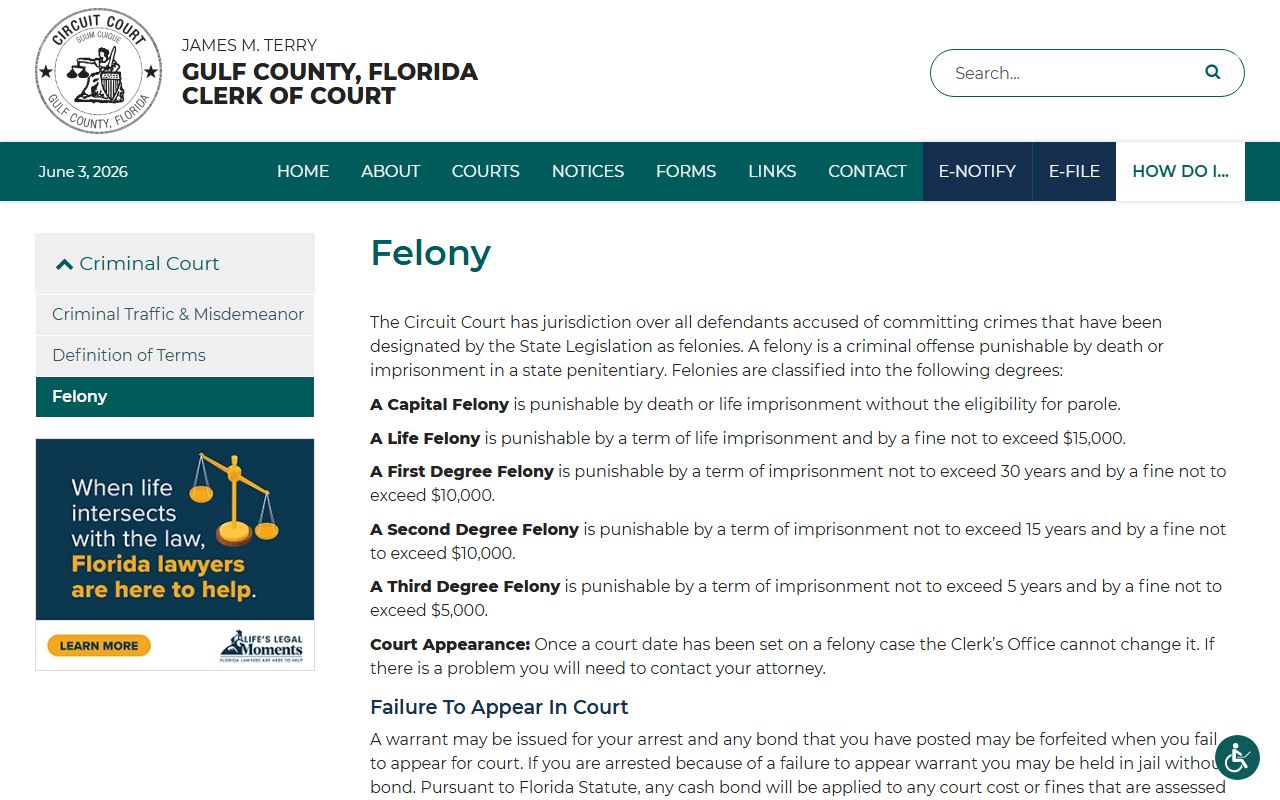
For case status by phone, the clerk lists extension 2305 for criminal traffic and misdemeanor matters and extension 2310 for felony and appeals, reachable at 850-229-6112 or 850-639-5068.
Background Check Considerations
Public court records are open to anyone, but using them to make certain decisions triggers federal rules. A formal background check used for hiring, housing, credit, or insurance falls under the Fair Credit Reporting Act and must go through a compliant consumer reporting agency. A casual lookup of a public docket does not.
Important: This site is not an FCRA-regulated consumer reporting agency, and its content may not be used for employment, housing, credit, or insurance screening.
Restricted Court Records After an Arrest in Gulf County
Not every record after an arrest is open. Florida's public-records exemptions in statute 119.071 shield active criminal investigative information and some protected-person details, and a sealed or expunged case drops out of public view. Juvenile delinquency matters are handled separately and are not treated like adult court records. When the clerk or the sheriff withholds part of a file, Florida law requires them to cite the specific exemption rather than simply decline.